Acacia senegal
The standard species for beverage emulsion, cannabis nano-emulsion, and flavor encapsulation. Spray-dried powder and agglomerated, conventional and Oregon Tilth certified organic. In US stock.
The standard species for beverage emulsion, cannabis nano-emulsion, and flavor encapsulation. Spray-dried powder and agglomerated, conventional and Oregon Tilth certified organic. In US stock.

Beverage emulsion stabilized by acacia. Senegal is the standard species for emulsions.
Acacia senegal is one of two commercially harvested gum acacia species, both native to the Sahel region. The dried exudate is cleaned and spray-dried into a fine, free-flowing powder, or further agglomerated for improved flow and reduced dust. PAT stocks both forms in conventional and Oregon Tilth NOP certified organic grades, in US warehouses, with full lot documentation.
The functional advantage of senegal over seyal sits in the arabinogalactan-protein (AGP) fraction. AGP is the surface-active component of gum acacia: the protein portion adsorbs to oil-water interfaces, and the polysaccharide chains extend into the aqueous phase to form a thick steric barrier around oil droplets. Senegal's higher AGP content means more interfacial coverage per unit of acacia, which is why it is the standard species for any application where droplet stability is load-bearing: beverage emulsion concentrates, cannabis and functional beverage nano-emulsion, flavor emulsion concentrates, and hard-texture molded confectionery where the gum carries the binder load.
The other commercial species, Acacia seyal, carries a higher total polysaccharide fraction and a lower AGP load, which makes it the standard for spray-dried flavor encapsulation, confectionery panning and coating, fiber fortification, and tablet binding. Both species are gum acacia under INS 414 / E414 and are used interchangeably by name in some regulatory contexts.
For a side-by-side view of which species each application calls for, the grade guide lists 84 formats with the species, form and color sensitivity for each.
Beverage emulsion concentrates typically use gum acacia at 20 to 30 percent of the concentrate weight. In the finished drink, effective gum acacia concentration is 0.3 to 1.0 percent. Senegal is the standard species because of its AGP content and resulting film-forming performance.
Acacia carries the cannabinoid load through 20 to 200 nm droplets generated by high-shear or microfluidization. The premix builds on a pre-acidified aqueous phase to pH 3.2 to 3.8, which is the acacia stability window. See our cannabis nano-emulsion article for the pH chemistry and our cannabis gummy article for the formulation that folds the premix into a pectin syrup.
In molded hard-candy formulas, senegal at roughly 35 percent of the formula carries the binder load alongside sucrose and glucose. The interfacial protein fraction is what holds flavor and texture through extended shelf life. For Scandinavian-type pastilles, the gum loading climbs to 45 to 50 percent. For panning shells, the right species is Acacia seyal, not senegal.
Gum acacia is the gold standard carrier for spray-dried flavor encapsulation. Acacia seyal is the preferred species for most encapsulation work because its lower viscosity at high solids enables higher feed-emulsion loads, but senegal is specified when interfacial strength matters more than throughput.
PAT stocks senegal in US warehouses, conventional and certified organic, with full lot documentation.
Request a Sample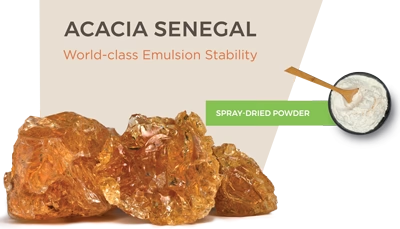
Fine, free-flowing powder for fast dissolution and direct addition to aqueous phases. Available conventional and Oregon Tilth certified organic.
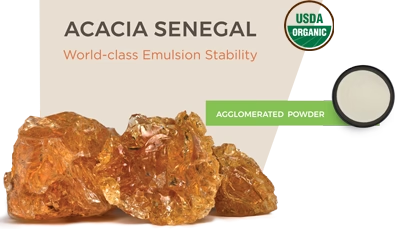
Larger particle size, improved flowability, reduced dustiness. Preferred for large-volume dry-handling and dust-sensitive operations. Available conventional and Oregon Tilth certified organic.
CoA and SDS ship with every order. The full regulatory pack (manufacturer spec sheet, allergen and GMO statements, Kosher and Halal certificates, country of origin, and the manufacturer's FSSC 22000 audit) is available on request through PAT's regulatory team. For Oregon Tilth certified organic grades, the NOP organic certificate ships with the lot. PAT's organic certification is documented at organic gum acacia sourcing.
Both are commercially harvested gum acacia species native to the Sahel region. The functional difference is the arabinogalactan-protein (AGP) fraction. Acacia senegal carries a higher AGP content, which gives it stronger interfacial activity at the oil-water boundary. That makes senegal the preferred species for beverage emulsion stabilization, cannabis and functional beverage nano-emulsion, and any application where droplet stability is the primary requirement. Acacia seyal carries a higher polysaccharide fraction and a lower AGP load, which makes it the preferred species for spray-dried flavor encapsulation, fiber fortification, and tablet binding.
The AGP fraction adsorbs to the oil-water interface: the protein component anchors to the oil droplet surface, and the polysaccharide chains extend into the aqueous phase. The result is a thick steric barrier that resists coalescence, Ostwald ripening, and creaming through 12 to 18 months of typical beverage shelf life. Senegal's higher AGP content means more interfacial coverage per unit of acacia, which is the load-bearing property in any oil-in-water emulsion.
Yes. Acacia senegal is the standard gum acacia species for cannabis nano-emulsion premixes, including THC distillate, hash rosin, and CBD systems. The pH window for senegal's interfacial activity (3.2 to 3.8) overlaps with the cannabis beverage and gummy formulation windows, which is why citric acid and senegal work together cleanly in both applications. See our articles on the citric acid and acacia pH system and cannabis gummy formulation for the full chemistry.
Spray-dried powder (fine, free-flowing, fast dissolution) and agglomerated (larger particle size, improved flow, reduced dust). Both forms are available in conventional and Oregon Tilth NOP certified organic grades. All grades ship from US warehouses with lot-specific documentation.
Lot-specific CoA, manufacturer spec sheet, SDS, allergen statement, Non-GMO statement, Kosher and Halal certificates, country of origin statement, and the manufacturer's FSSC 22000 audit certificate. For Oregon Tilth certified organic grades, the NOP organic certificate ships with the lot. Full documentation pack on request.
Acacia senegal is native to the Sahel region and is harvested from wild and managed stands. PAT sources through a long-standing relationship with a German manufacturer. The acacia is cleaned, dissolved, spray-dried, and packaged at FSSC 22000 certified facilities in Germany before shipping to US warehouses. That processing is the substantial transformation that sets country of origin, so the country of origin of PAT's gum acacia is Germany.
Yes. PAT's organic Acacia senegal grades are Oregon Tilth NOP certified. The certification covers the spray-dried powder and agglomerated forms. Organic gum acacia is one of the few directly certifiable organic emulsifiers in beverage and supplement work, which makes it a strong fit for NOP-certified products. See our article on NOP organic beverage formulation with citric acid and organic gum acacia.
Gum arabic, gum acacia, acacia gum, and acacia fiber are the same ingredient class, encompassing both Acacia senegal and Acacia seyal. The terms are used interchangeably in regulatory documents (INS 414 / E414), trade, and formulator literature.
"Acacia fiber" is the common label name on US supplement and functional-food products since FDA recognized the material as a dietary fiber under 21 CFR 101.9, and is the term many purchasing agents use on procurement specs. When a spec calls for "gum arabic" without naming the species, the buyer typically wants Acacia senegal for emulsification work and Acacia seyal for encapsulation work.
The other commercial gum acacia species. Higher polysaccharide fraction, lower AGP. Preferred for spray-dried flavor encapsulation, fiber fortification, and tablet binding.
Acacia seyal →Food-grade anhydrous USP/FCC fine granular 30–80 mesh. Pairs with Acacia senegal for pH-stable cannabis beverage emulsion and gummy formulation. Both in US stock.
Citric Acid →Overview, species comparison, and grade selection across both Acacia senegal and Acacia seyal.
Gum Acacia overview →Organic grades certified by Oregon Tilth NOP. Manufacturer certified to FSSC 22000. Kosher and Halal documentation per lot. Non-GMO.