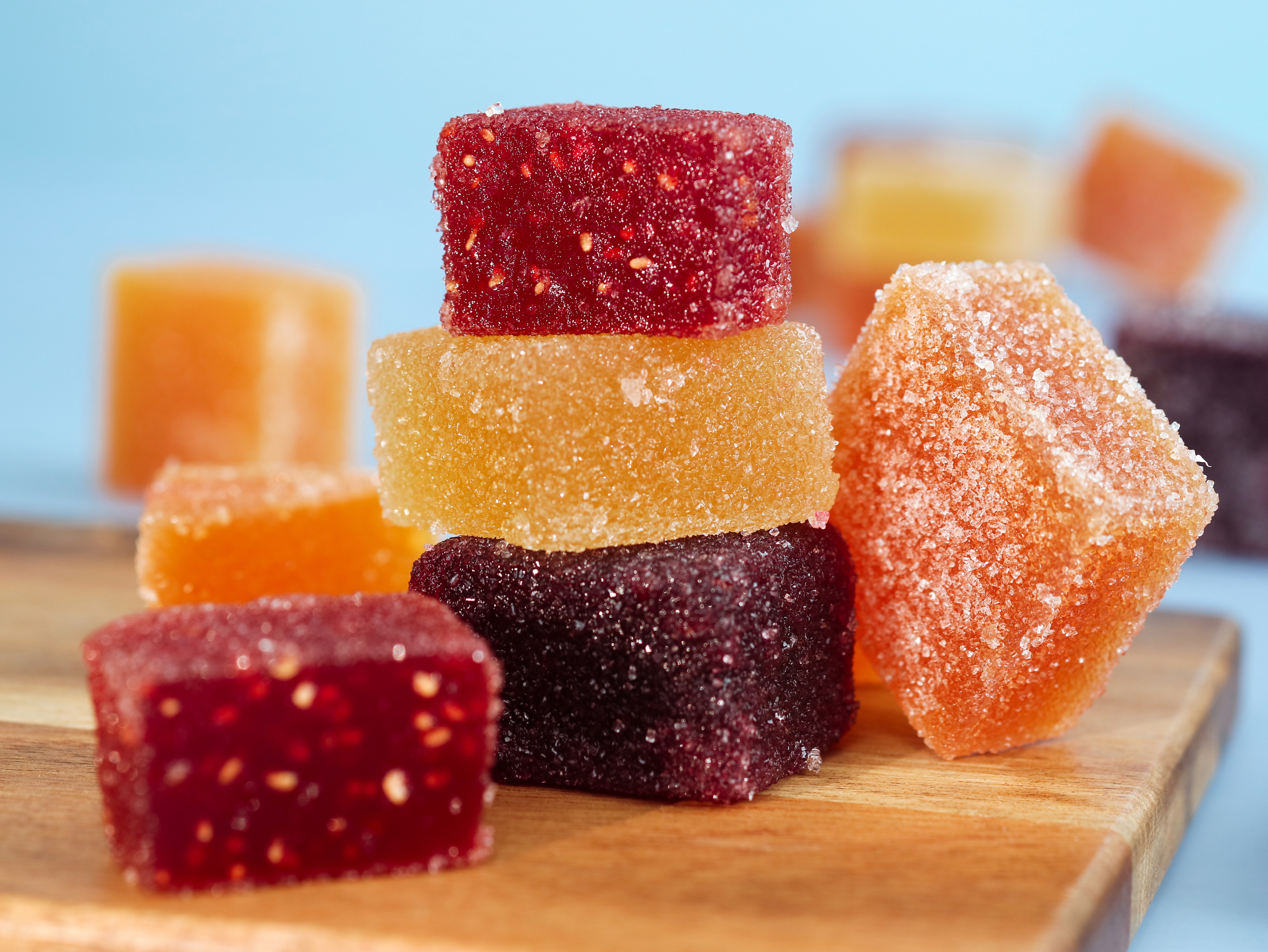
A cannabis gummy with a fast-onset nano-emulsified cannabinoid has to satisfy two pH windows at once. The pectin gel needs pH 3.0 to 3.5 to set. The gum acacia or quillaja interface around the cannabinoid droplets needs pH 3.2 to 3.8 to stay intact. The overlap is a 0.3-unit band between pH 3.2 and 3.5. Drift outside and one of two things fails: the gummy doesn't gel, or the cannabinoid emulsion cracks within days of packaging.
Citric acid does most of the pH work in both directions. Gum acacia carries the cannabinoid load through the nano-emulsion premix before it folds into the syrup.
The pectin set window
High-methoxyl (HM) pectin is the dominant gelling agent in fast-onset cannabis gummies. It is plant-derived and vegan. HM pectin sets in a high-sugar, low-pH environment: typically 60 to 70 percent soluble solids and pH 3.0 to 3.5. Above pH 3.5 the gel weakens because the carboxyl groups on the pectin chains stay ionized and the chains don't crosslink through hydrogen bonding. Below pH 3.0 the gel sets too fast at deposit, leaving short pectin chains and a brittle texture.
Low-methoxyl (LM) pectin extends the working window to pH 3.5 to 4.5 but requires divalent calcium to crosslink. That introduces a complication for citric-heavy formulas: citric chelates calcium. At deposit-level citric load (0.5 to 1.5 percent), the calcium pool from sugar, glucose syrup, and any added calcium salt is usually enough to satisfy LM gelation. At higher citric loads, the gel weakens because the available calcium binds to citrate before reaching the pectin crosslinks. The practical result: HM pectin is the safer choice when citric is doing heavy pH work.
Gelatin is the conventional alternative. It tolerates pH 3.0 to 4.5 broadly and is more forgiving on add-order timing. The tradeoff is the natural-channel positioning. Gelatin also tolerates higher citric loads in the deposit (0.8 to 2.0 percent), but above 3 percent citric the gelatin Bloom strength drops irreversibly within 24 hours of storage.
The cannabinoid nano-emulsion window
Fast-onset cannabis gummies deliver the cannabinoid through a nano-emulsion premix that folds into the syrup. The premix is built separately: an aqueous phase, a stabilizer (gum acacia or quillaja saponin), and the cannabinoid oil (typically THC distillate, sometimes hash rosin or a CBD oil for non-THC products). High-shear or microfluidization reduces droplet size to 20 to 200 nanometers, which is the size range that delivers the fast-onset absorption profile.
The stabilizer at the oil-water interface is pH-sensitive. Gum acacia loses interfacial activity below pH 2.8 (the carboxylate groups on the polymer's glucuronic acid side chains protonate, the chain collapses, droplets begin coalescing) and above pH 4.5 (the polymer solubilizes but its affinity for the oil interface drops). Quillaja saponin precipitates below 2.8 and loses function above 5.5. Both stabilizers are at their useful conformation in pH 3.2 to 3.8.
The full chemistry of why this band is what it is, with the Henderson-Hasselbalch buffer math and the add-order sequence for the premix itself, is covered in our article on cannabis nano-emulsion stability with citric acid and gum acacia.
The overlap is 0.3 pH units
The pectin set window (3.0 to 3.5) and the nano-emulsion stability window (3.2 to 3.8) overlap at pH 3.2 to 3.5. That 0.3-unit band is the working envelope for the finished gummy. Inside it, the gel sets cleanly and the cannabinoid droplets stay intact through cooling, packaging, and shelf storage. Outside it, one or both fail.
The midpoint, pH 3.35, is the practical target for the syrup before deposit. Hitting that consistently across production batches requires controlling three variables: the citric load in the deposit, the water hardness of the process water (hard water above 200 ppm CaCO3 buffers acid and requires 10 to 25 percent more citric to reach target pH), and the post-cook addition timing for the citric itself.
Where citric acid does the work
Citric acid does three distinct jobs in a cannabis gummy that uses a nano-emulsified cannabinoid.
One: primary pH adjuster. Citric pKa1 at 3.13 sits in the middle of the target band, so titrating citric to pH gives reproducible batch-to-batch results. Use rate in the gummy deposit is 0.5 to 1.5 percent w/w for pectin systems, added late in the process to avoid acid hydrolysis of pectin chains during the cook. Anhydrous fine granular 30 to 80 mesh is the form for the deposit step because it dissolves fast in a cooling syrup.
Two: sour profile. Citric carries the front-loaded sourness in the deposit. For sour-positioned products, an additional dust coating runs 5 to 15 percent citric on the gummy surface, sometimes higher with an oil-tumbling step. The coating uses monohydrate citric (7.5 to 9.0 percent bound water) rather than anhydrous, because the bound water creates a slower, more sustained sour burst when the gummy contacts saliva. Many sour profiles blend citric with malic at a 2:1 to 3:1 citric-to-malic ratio: citric gives the front-load punch, malic extends the sour duration. Pure citric reads as sharper and shorter; pure malic reads as flatter and longer.
Three: transition metal chelator. Citric binds iron, copper, and manganese, the trace metals that catalyze terpene and cannabinoid oxidation. In a finished gummy with citric at 0.5 to 1.5 percent in the deposit, that chelation extends cannabinoid potency retention over the typical 12 to 18 months of shelf storage. The same chelation function justifies citric over alternative acidulants in cannabis beverage emulsions; in gummies, it runs as a quiet co-benefit on top of the pH and sourness work.
Where gum acacia does the work
Gum acacia works in the cannabinoid nano-emulsion premix that folds into the syrup, upstream of the gel structure. Acacia senegal spray-dried powder is the preferred grade because of its higher arabinogalactan-protein (AGP) content. The AGP fraction anchors to the oil-water interface, the polysaccharide chains extend into the aqueous phase, and the combination forms a steric barrier around each cannabinoid droplet that resists coalescence and Ostwald ripening through 12 to 18 months of typical edible shelf life.
The premix is built before the gummy syrup, with gum acacia fully hydrated in the acidified aqueous phase. Incomplete acacia hydration is a common source of finished-product instability. The qualitative direction: more acacia gives better interfacial coverage and tighter droplet stability at the cost of higher batch viscosity during emulsification. The exact ratio is cannabinoid-load and droplet-size specific, and belongs on a bench protocol rather than a published number.
Two parallel streams, one sensitive convergence point
The nano-emulsion premix and the gummy syrup run as separate streams. The premix follows standard cannabis nano-emulsion practice, covered in detail in our article on the citric acid and acacia pH system: acidified aqueous phase first, full acacia hydration second, cannabinoid oil combined under high-shear or microfluidization third. The gummy syrup follows the pectin grade's cook specification, which varies by manufacturer, equipment, and target solids.
The streams converge after the syrup has cooled enough to spare the cannabinoid from thermal degradation, but not so far that syrup viscosity closes the deposit window before pectin sets. Both temperature gates are pectin-grade and equipment specific. The specific number for any given line belongs on the production floor with a formulator who knows the equipment.
A common failure mode is post-fold citric addition without pre-dissolution. If the syrup reads slightly under the target pH after the emulsion goes in, the instinct is to dissolve a small additional dose of citric directly into the syrup. The localized pH gradient at the dissolution point briefly drops pH below the acacia stability threshold in adjacent droplets. The damage is invisible at deposit and shows up as cannabinoid oil separation within days of packaging. Any post-fold acid adjustment goes through a pre-dissolved water carrier, never as a dry solid into the syrup.
Failure modes with diagnostic timing
Cannabis gummies fail in characteristic ways that point back to the manufacturing step where the problem entered.
Weak gel, syneresis at 7 to 10 days post-deposit: the pectin gelled but the matrix is short. Likely cause: citric added too early in the cook, hydrolyzing pectin chains before set. Direction: shift citric addition later in the process.
Cannabinoid oil bleed at 3 to 7 days post-packaging: the nano-emulsion interface cracked during cooling or final citric adjustment. Likely cause: post-fold citric addition without pre-dissolution, creating local pH gradients. Or the syrup was still too hot when the premix went in, where the threshold is grade and equipment specific but real. Direction: pre-dissolve any post-fold citric in cooled water before adding, and confirm syrup temperature at the fold step against the line's qualified range.
Cannabinoid potency loss greater than expected at 6 to 12 months: insufficient chelation against transition metals, often combined with light or oxygen exposure in packaging. Likely cause: citric load in the deposit at the low end of the range, hard water with elevated iron content, or oxygen-permeable packaging. Direction: confirm finished-product citric load against batch records, consider RO water for the aqueous phase, and review packaging oxygen transmission rate.
Astringent or harsh finished gummy: citric load in the deposit above 3 percent, or sour coating applied too heavily on top of an already-acidic deposit. Direction: reduce deposit citric and shift more of the sour load to the coating, where the monohydrate slow-release profile reads cleaner on the palate than concentrated deposit citric.
Gel sets in the deposit head before transfer to molds: deposit window too short, syrup temperature too low at the late-process citric addition, or pectin grade mismatched to the production line speed. Direction: raise the late-process addition temperature within the line's working range, switch to a slower-set pectin grade, or shorten the time between citric addition and deposit.
Documentation for state cannabis programs
Cannabis edibles manufacturers in regulated state markets (Maine, Massachusetts, New York, New Jersey, Connecticut, and others) need traceable lot-level documentation on every input. For citric acid, that means lot-specific CoA, allergen statement, GMO statement, country of origin, and the manufacturer's BRC or FSSC audit certificate. PAT's citric is non-Chinese origin, AD/CVD cleared, with origin documentation on every lot.
For gum acacia, the doc pack covers lot-specific CoA, allergen, Non-GMO statement, Kosher and Halal certificates, country of origin, and the manufacturer's FSSC 22000 audit. Organic versions (Oregon Tilth certified) carry the NOP organic certificate as well. State programs accept either conventional or organic, but brands building organic-positioned products will want the certified grades. The full breakdown of how citric and organic gum acacia fit together in NOP-certified edibles is in our article on NOP organic beverage formulation with citric acid and organic gum acacia.
Both inputs ship from US inventory. A single PO covering both produces a single audit-ready document set rather than two parallel chains.
Frequently asked
What pH should I target for a cannabis gummy with a nano-emulsified cannabinoid?
Target pH 3.2 to 3.5. That band is the overlap between the HM pectin set window (3.0 to 3.5) and the gum acacia nano-emulsion stability window (3.2 to 3.8). Above 3.5 the pectin gel weakens; below 3.2 the acacia interface around the cannabinoid droplets destabilizes.
Why is the working pH window narrower for cannabis gummies than for conventional fruit gummies?
A conventional fruit gummy only has to satisfy the pectin set window. A cannabis gummy with a nano-emulsified cannabinoid has to satisfy that AND the emulsion stability window simultaneously. The two windows overlap at 3.2 to 3.5, a 0.3-unit band.
Citric or malic acid for the syrup pH adjustment?
Citric for the primary pH adjustment. Its pKa1 at 3.13 sits in the middle of the target window. Malic at a 2:1 to 3:1 citric-to-malic blend extends sour duration on the palate without disrupting pH control. Malic alone is harder to land precisely in the 3.2 to 3.5 band because its pKa1 (3.40) sits just above the target.
What is the typical citric acid use rate in a cannabis gummy deposit and sour coating?
0.5 to 1.5 percent w/w in the pectin gummy deposit, added late in the process to avoid acid hydrolysis of pectin chains during the cook. 5 to 15 percent in the sour coating dust, sometimes higher with an oil-tumbling step. Gelatin deposits tolerate 0.8 to 2.0 percent without gel weakening. Above 3 percent citric in any deposit, finished gummies become astringent.
Why anhydrous citric for the deposit and monohydrate for the sour coating?
Anhydrous (≤0.5 percent moisture) fine granular dissolves fast in a cooling syrup at the late-process addition step. Monohydrate (7.5 to 9.0 percent bound water) is used in sour coating because the bound water creates a slower, more sustained sour burst on the tongue when the gummy hits saliva.
How do I keep the nano-emulsion stable when it folds into the gummy syrup?
Build the nano-emulsion premix separately with the aqueous phase pre-acidified to the target band before acacia hydration and high-shear emulsification, per standard cannabis nano-emulsion practice. Fold it into the syrup once the cook has cooled enough to spare the cannabinoid from thermal degradation, but not so far that syrup viscosity closes the deposit window. Both temperature gates are pectin-grade and equipment specific. Any post-fold acid adjustment should be pre-dissolved in water before adding to the syrup.
Can I use gelatin instead of pectin for a fast-onset cannabis gummy?
Yes. Gelatin tolerates a broader pH range and is more forgiving on add-order timing, but it loses the vegan/natural-channel positioning. Most fast-onset cannabis gummies in regulated state markets run pectin for the brand positioning, not because the chemistry forces it.
Does the citric in the deposit affect cannabinoid stability over shelf life?
Yes. Citric chelates iron, copper, and manganese, the trace transition metals that catalyze terpene and cannabinoid oxidation. At deposit-level citric load, that chelation extends cannabinoid potency retention over 12 to 18 months of typical shelf storage. The citric in the deposit does three jobs at once: pH adjuster, sour profile, and transition metal chelator for shelf life.
Citric acid and gum acacia for cannabis edibles, from one supplier
PAT stocks food-grade citric acid anhydrous USP/FCC fine granular 30–80 mesh for the gummy deposit and sour coating work, and gum acacia in conventional and Oregon Tilth certified organic grades for the cannabinoid nano-emulsion premix. Both in US stock for cannabis edibles manufacturers, both documented on every lot.
Request samples