Guar gum
A cold-soluble thickener and stabilizer used in food, dairy, supplements, oil and gas, and a range of industrial applications. Two viscosity grades, conventional and organic.
A cold-soluble thickener and stabilizer used in food, dairy, supplements, oil and gas, and a range of industrial applications. Two viscosity grades, conventional and organic.
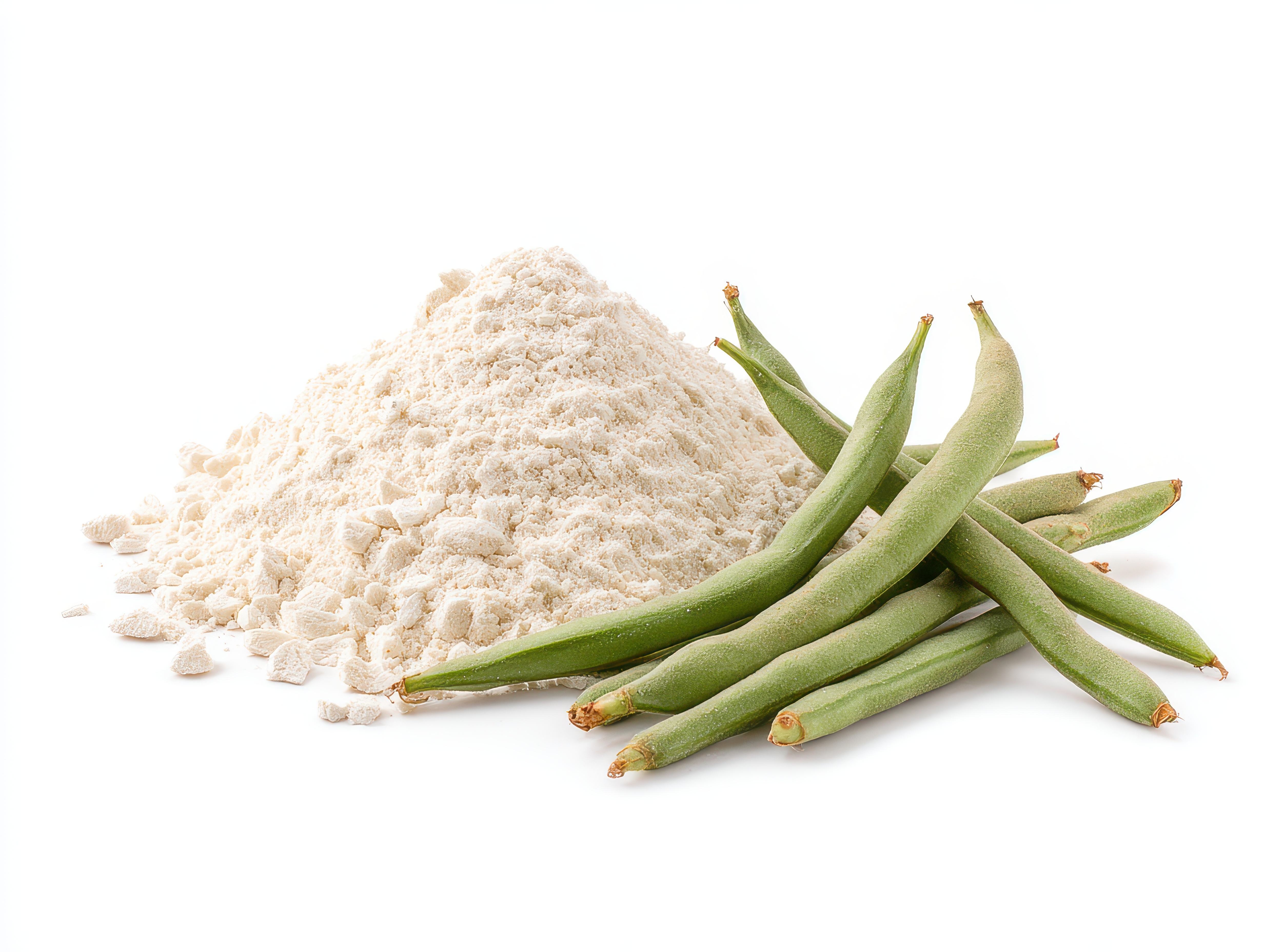
Guar gum is a galactomannan polysaccharide milled from the endosperm of the guar bean (Cyamopsis tetragonoloba). It hydrates rapidly in cold water to form a viscous solution at low use levels, typically 0.1–0.5% depending on the application. Per gram, it produces more viscosity than almost any other natural hydrocolloid.
We carry two conventional grades in commercial stock. Certified organic versions of both grades are available for sampling. All four variants are Kosher and Halal certified.
Disperses and hydrates in cold water without requiring heat. Useful in ready-to-mix powder applications and cold-process food systems where thermal treatment is not possible.
At 0.1% in water, the viscosity effect is measurable. Most food applications run between 0.1–0.3%. A small addition goes a long way, which matters for both cost and clean-label ingredient lists.
Guar gum is classified as a dietary fiber under FDA 21 CFR 101.9. At effective use levels it contributes measurable fiber content, which can support fiber claims on the label.
Viscosity is the primary difference between grades. Both are 200 mesh fine powder with the same gum content, pH range, and microbiological specifications. The choice comes down to how much viscosity your application requires.
Conventional grades are in commercial stock. Organic versions of both grades are available for sampling.
3,500–4,000 cps · 200 mesh · Light cream to off-white fine powder
A moderate-viscosity grade suited to dairy, bakery, sauces, supplements, and standard industrial applications. Available conventional (commercial stock) and organic (sample stock).
5,000–5,500 cps · 200 mesh · White fine powder
A higher-viscosity grade for applications that require stronger gel strength or greater thickening efficiency per gram. Available conventional (commercial stock) and organic (sample stock).
Guar gum runs in ice cream and frozen desserts, sauces and dressings, bakery, beverages, pet food and supplement powders. The common thread is viscosity, texture control, or stabilization at low cost and low use level.
Ice cream, frozen yogurt, sour cream, and cream cheese. Guar gum slows ice crystal growth during temperature cycling, maintains body and texture, and controls meltdown rate. Frequently combined with locust bean gum or carrageenan for synergistic stabilization.
Moisture retention, crumb softness, and extended shelf life in breads, muffins, and gluten-free formulations. In gluten-free applications it provides structure and cohesion in the absence of gluten's network-forming properties.
Viscosity control and suspension of particulates in pourable dressings, marinades, and sauces. Performs well in acidic systems.
Binder and disintegrant in tablets and capsules. Viscosifier in liquid supplement formulas and meal replacements. Contributes fiber content in fiber supplement applications.
Guar gum has a large industrial market that runs parallel to its food uses. The same cold-water hydration and high viscosity efficiency that make it useful in food systems make it the polymer of choice for several demanding industrial applications.
Guar gum is the primary polymer used in hydraulic fracturing. Hydrated at concentrations of 0.5–2%, it forms a viscous gel that carries proppant (sand or ceramic media) into fractures in the rock formation, holding them open after pressure is released. In drilling operations it improves mud rheology, lubricates the drill bit, and stabilizes the borehole wall.
In hydroseeding, guar gum acts as a tackifier. As the slurry dries, it bonds seed, fertilizer, and mulch to the slope surface and holds the material in place until vegetation establishes. Common in highway construction, mine reclamation, and slope rehabilitation.
In froth flotation circuits, guar gum is used as a gangue depressant. It selectively coats non-target minerals to improve separation efficiency. Also used in heap leach operations and tailings management as a binder and viscosifier.
In papermaking, guar gum improves sheet strength, printability, and smoothness as a surface sizing agent and wet-end additive. In textile manufacturing it strengthens warp yarn during weaving and serves as a printing paste thickener for fabric finishing.
Specifications below apply to both grades. Viscosity ranges and appearance differ between grades as noted.
| Parameter | Specification |
|---|---|
| Appearance — RG-235 | Light cream to off-white fine powder |
| Appearance — RG-250 | White fine powder |
| Viscosity — RG-235 (1% solution, 24 hr) | 3,500–4,000 cps |
| Viscosity — RG-250 (1% solution, 24 hr) | 5,000–5,500 cps |
| Particle size | ≥95% through 200 mesh |
| Gum content | 80% min. |
| Moisture | 12% max. |
| pH (1% solution) | 5.5–7.0 |
| Ash content | 1% max. |
| Acid insoluble residue | 3% max. |
| Protein | 5% max. |
| Fat | 0.8% max. |
| Starch | Negative |
| Aerobic plate count | ≤5,000 CFU/g |
| Molds and yeast | ≤500 CFU/g |
| Coliform | Negative |
| E. coli | Absent |
| Salmonella | Absent / 25g |
| Arsenic | ≤2 ppm |
| Lead | ≤2 ppm |
| Mercury | ≤1 ppm |
| Cadmium | ≤1 ppm |
| Shelf life | 24 months from manufacture |
| Certifications | Kosher, Halal |
Guar gum pairs well with locust bean gum and carrageenan in dairy and frozen applications. Guar provides fast cold-water viscosity buildup; locust bean gum adds freeze-thaw stability and heat-shock resistance; carrageenan contributes body and prevents whey separation. The combination typically outperforms any single stabilizer at equivalent total usage levels.
It also combines with xanthan gum in gluten-free baking, where the two gums work together to replicate some of the viscoelastic properties of gluten.