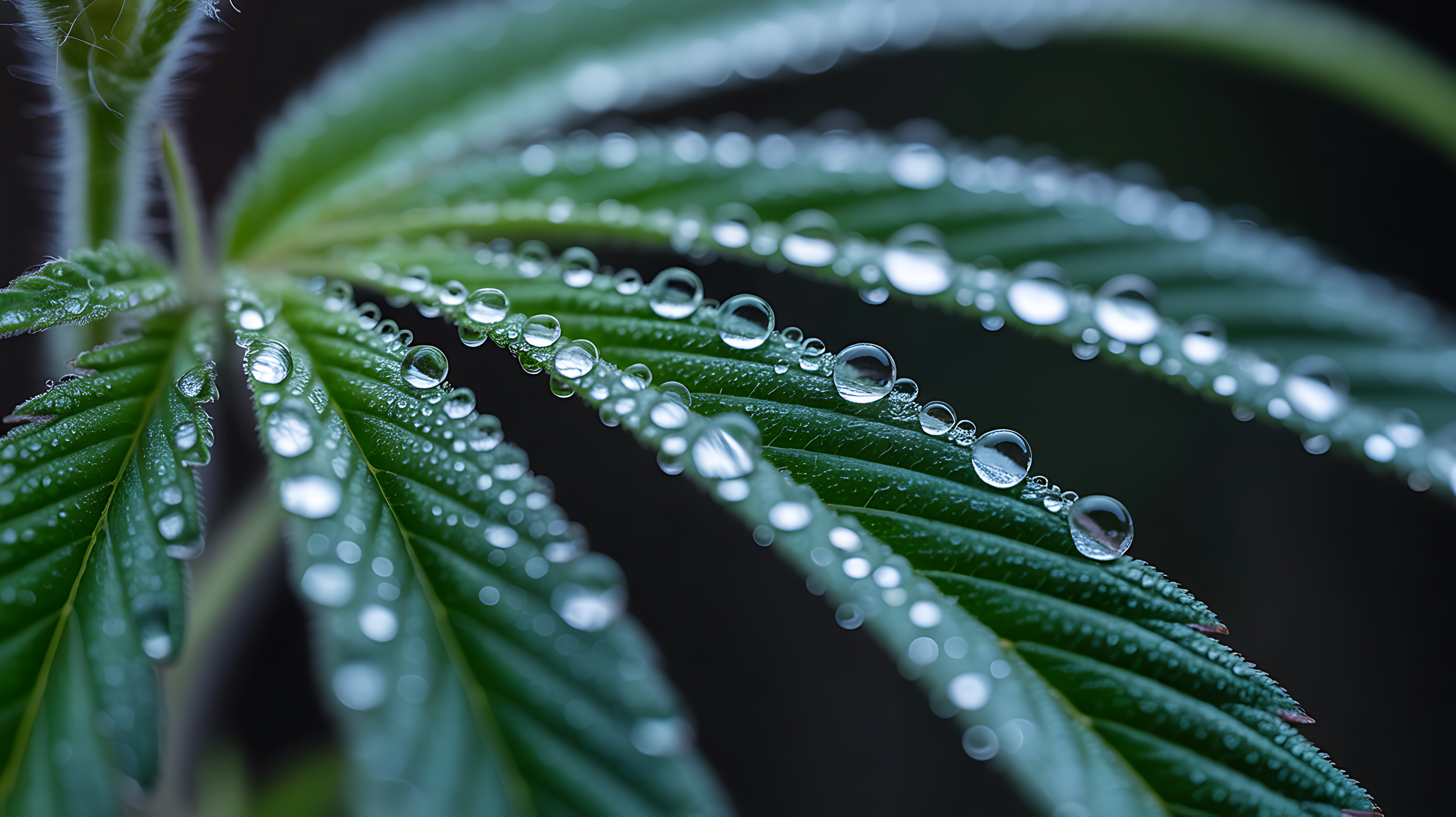
THC and CBD are oil-soluble. Delivering them evenly distributed in a water-based beverage requires a stable oil-in-water emulsion. Without one, the oil phase separates, cannabinoids concentrate unevenly in the bottle, and dosing becomes inconsistent.
Gum acacia is one of the standard natural emulsifiers used to solve this problem.
Why emulsion stability matters more in cannabis beverages
Separation in a cannabis beverage creates dosing inconsistency. If the cannabinoid-bearing oil phase settles or creams to the top of the container, the first sip of the product delivers a different dose than the last. For a product sold on precise dosing, that's a quality and regulatory problem.
Most commercial cannabis beverages today run nano-emulsion systems (droplets under 200 nm) instead of coarse emulsions, which introduces a distinct set of stabilizer considerations around Ostwald ripening and interfacial loading. Those specifics are covered in our article on nano-emulsion stabilizers for cannabinoid and functional beverages. The same nano-emulsion also drives fast-onset cannabis gummies, where the premix folds into a pectin syrup instead of diluting into a finished beverage.
How gum acacia stabilizes the emulsion
The arabinogalactan-protein (AGP) fraction in Acacia senegal does the primary emulsification work. The protein portions anchor to the oil droplet surface; the polysaccharide portions extend into the water phase, creating a dense steric barrier around each droplet. This barrier prevents the droplets from coalescing and separating, even through temperature cycling and extended shelf life.
The result is a fine, stable oil-in-water emulsion that holds through the conditions typical of a packaged beverage: ambient storage, refrigeration, shipping, and retail display.
Clarity and turbidity
Whether the finished beverage needs to be clear or can be cloudy is a product specification decision, but it shapes the emulsification target significantly. Cloudy cannabis beverages tolerate larger droplet sizes. Clear RTDs (sometimes called cannabis water or CBD water) require droplets well under 200 nm, typically under 100 nm. At this size, droplets don't scatter visible light enough to cause turbidity.
Gum acacia supports this size range when combined with appropriate high-energy processing: high-pressure homogenization or microfluidization. At typical use levels in finished beverages, gum acacia is optically inactive: it adds no color or haze of its own.
Clean label fit
Many cannabis beverage brands are natural-positioned or organic-positioned. The category skews toward plant-derived ingredients, minimal processing, and recognizable ingredient lists. Gum acacia fits that positioning well. It declares as "gum acacia" or "gum arabic" on the ingredient label, both plant-derived ingredient names.
For brands that carry USDA Organic certification on their cannabis products, an organic-certified gum acacia supply is needed to maintain that certification. PAT's Type 4886 covers that requirement.
Gum acacia vs. lecithin
Lecithin is the other natural emulsifier most often evaluated alongside gum acacia for cannabis beverage applications. It works through a different mechanism: lecithin is a phospholipid that forms micelles rather than building a steric barrier around droplets. It emulsifies efficiently at lower concentrations and requires less processing energy to achieve target droplet size.
The tradeoff is stability over time. Lecithin-stabilized emulsions are more susceptible to Ostwald ripening and coalescence, particularly through temperature cycling and in the presence of alcohol. For products with 12–18 month shelf life requirements, gum acacia's steric barrier mechanism holds more reliably. For short shelf-life products or when initial emulsification ease is the priority, lecithin can work.
Some formulations use both: lecithin for initial droplet formation efficiency, gum acacia for long-term steric stabilization. This combination is worth evaluating when both ease of manufacture and shelf life are hard requirements.
Grade selection
For cannabis beverage emulsification, Acacia senegal is the standard species. Type 4687 (standard spray-dried) is a good starting point for formula development. Type 4810 (agglomerated, fast-hydrating) is preferred for production-scale operations where hydration time is a constraint; emulsification performance is equivalent. Type 4886 is the organic agglomerated senegal, Oregon Tilth certified, for brands carrying USDA Organic certification.
Use levels and technical notes
Typical gum acacia use in cannabis beverage emulsion concentrates is 20–30% by weight (dry basis), with oil-to-gum ratios in the range of 1:2 to 1:3. In the finished beverage, effective gum acacia concentration is typically 0.3–1.0% by weight.
Gum acacia is stable across the pH range typical of cannabis beverages (pH 3.5–6.5). It doesn't interact with cannabinoids and functions as an inert emulsifier: it carries the oil phase but doesn't affect the pharmacological properties of the cannabinoids.
All grades are Kosher and Halal certified. GRAS per 21 CFR 184.1330.
Frequently asked
How does gum acacia ensure consistent cannabinoid dosing in beverages?
Consistent dosing depends on a stable emulsion. The cannabinoid-bearing oil phase needs to stay evenly distributed throughout the beverage volume from the first pour to the last. Gum acacia's arabinogalactan-protein (AGP) fraction builds a dense steric barrier around each oil droplet, resisting coalescence and preventing phase separation through storage, temperature cycling, and shelf life. The result is uniform cannabinoid concentration per serving rather than dose accumulation at the top or bottom of the container.
What is a CBD water emulsion?
A CBD water emulsion is an oil-in-water emulsion in which CBD oil is dispersed in water as fine droplets stabilized by an emulsifier. For optically clear products, droplet size is typically under 100 nm. At this size, droplets don't scatter visible light. Gum acacia is used in this application for its steric barrier mechanism, which provides long-term stability for shelf-stable packaged formats.
Is gum acacia approved for use in cannabis and CBD beverages?
Yes. Gum acacia is GRAS per 21 CFR 184.1330 and an approved food additive under FDA regulations. It is Kosher, Halal, non-GMO, and available in Oregon Tilth certified organic grades. Its use in cannabis and CBD beverages follows the same regulatory framework as its use in any food or beverage product.
How does gum acacia compare to lecithin for cannabis beverage emulsification?
Lecithin emulsifies at lower concentrations and requires less processing energy, but produces emulsions that are less stable over extended shelf life. Gum acacia's steric barrier mechanism is more resistant to Ostwald ripening and coalescence, particularly for products with 12–18 month shelf life targets. Some formulations combine both: lecithin for initial droplet formation, gum acacia for long-term stability.
What use level of gum acacia is needed for a stable cannabinoid emulsion?
In the emulsion concentrate, gum acacia is typically 20–30% by weight (dry basis), with oil-to-gum ratios in the range of 1:2 to 1:3. In the finished beverage, effective concentration is typically 0.3–1.0% by weight. Actual use levels depend on oil phase concentration, processing equipment, target droplet size, and pH.
Which gum acacia grade is best for cannabis beverage emulsification?
Acacia senegal is the standard species. Type 4687 (spray-dried) suits formula development. Type 4810 (agglomerated, fast-hydrating) suits production scale where hydration time is a constraint. Emulsification performance is equivalent. Type 4886 is the Oregon Tilth certified organic grade for brands carrying USDA Organic certification.
Grade guidance for cannabis beverage emulsification
Acacia senegal grades (Types 4687, 4810, and 4886) for cannabis beverage emulsification. Type 4886 is Oregon Tilth certified organic for brands with NOP requirements.
Request a Sample