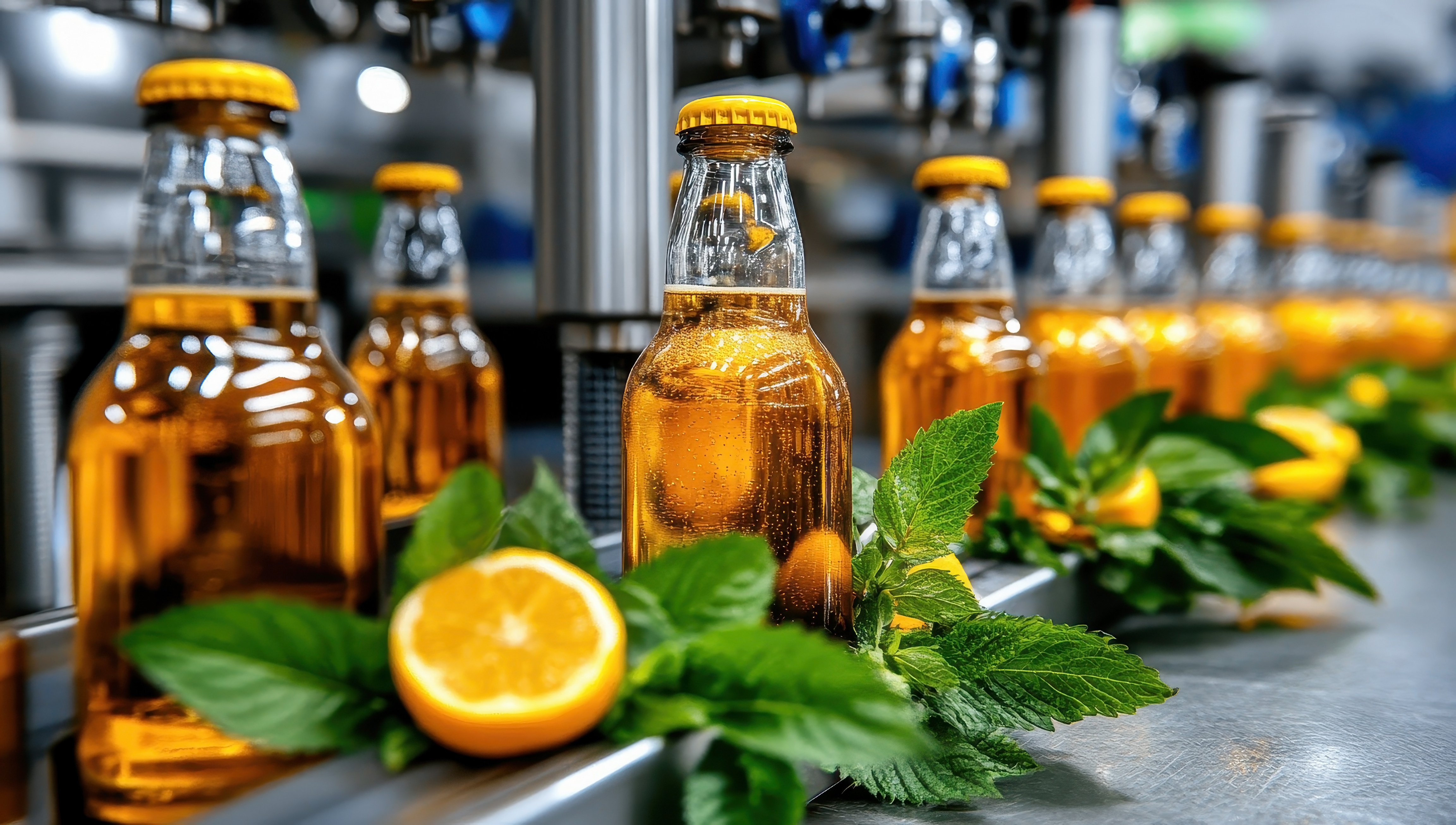
What is an acacia emulsion?
An acacia emulsion is an oil-in-water emulsion in which gum acacia serves as the primary emulsifier. Gum acacia adsorbs to the surface of oil droplets through its arabinogalactan-protein (AGP) fraction, forming a dense hydrophilic coating around each droplet that prevents them from coalescing. The result is a stable emulsion that holds up in acidic conditions, high-Brix syrups, carbonated systems, and across the temperature cycles found in commercial beverage manufacturing.
Gum acacia has been the standard emulsifier for beverage concentrates for decades. This guidance is for an emulsion that ships as a liquid. If the same emulsion is spray-dried into a powder the species answer changes, which is explained in why the species depends on whether you dry it.
Why gum acacia works for beverage emulsification
Gum acacia is a complex polysaccharide with a protein fraction bound at the core. The protein components anchor to oil droplet surfaces. The polysaccharide portions extend into the water phase, creating a dense hydrophilic coating around each droplet. That coating prevents droplets from coalescing.
The specific fraction responsible for most of the emulsification performance is the arabinogalactan-protein (AGP) complex. It makes up roughly 10–20% of gum acacia by weight but does the majority of the interfacial work. Higher AGP content generally means better emulsification performance.
The result is an emulsion that tolerates acidic conditions, high-Brix syrup, carbonation, and temperature cycling: the conditions found in most commercial beverage applications.
Why senegal is the preferred species for emulsification
Acacia senegal has a higher AGP content than Acacia seyal. That translates to better film formation at the oil-water interface, smaller initial emulsion droplet size, and more durable stability in challenging beverage conditions. For beverage emulsion applications, senegal is the species to start with.
Seyal works for beverage emulsification at lower performance requirements, but if your product is an acidic citrus RTD or a botanical beverage with demanding stability specs, senegal grades hold up better across the shelf life.
Solution viscosity is part of that picture too. What drives it, and why a viscosity figure means nothing without its measurement conditions, is in gum acacia viscosity: what to expect from senegal and seyal.
Grade selection
For beverage emulsification, Acacia senegal grades are the standard choice. Type 4687 (standard spray-dried) and Type 4810 (agglomerated, fast-hydrating) are equivalent in emulsification performance; 4810 disperses in 10–15 minutes vs. 20–30 for 4687, which matters in production environments where hydration time between batches is a constraint. For organic-certified beverages, Type 4886 is the agglomerated senegal with Oregon Tilth certification.
What buyers mean by "beverage emulsion grade"
Purchasing inquiries often ask for "spray-dried acacia senegal, beverage emulsion grade." The term describes a use case, not a separate industry designation: a fine, fully soluble spray-dried senegal powder with the intact protein fraction that does the emulsification work. Any well-processed spray-dried senegal with a current specification and per-lot certificate of analysis is the material the phrase points to.
What separates suppliers on this request is documentation and availability rather than the powder itself. We stock spray-dried Acacia senegal in US warehouses in conventional and Oregon Tilth certified organic grades, in 25 kg bags, with specifications written to FCC. Small orders ship quickly; a few bags for a pilot run and a pallet for production both come off the same shelf.
Use levels and application notes
In emulsion concentrates, gum acacia is typically used at 20–30% of the total concentrate weight (dry basis). The oil-to-gum ratio in the emulsion feed is commonly 1:2 to 1:3. Higher oil loads are achievable but require more careful emulsification to control droplet size.
In finished beverages, effective gum acacia concentration is usually 0.3–1.0% by weight, depending on the oil content and stability requirements.
Gum acacia tolerates the low pH conditions of citrus and botanical beverages well. It's stable in the range of pH 3.0–7.0, which covers most commercial beverage applications.
Applications
Citrus flavor emulsions for RTD beverages are the most established application. Botanical extract emulsions for NA aperitifs and functional beverages are a growing one. Essential oil dispersions, natural clouding agents, and emulsified terpene systems in sparkling beverages are also well within the capability of these grades.
Cannabinoid and functional nano-emulsion systems, where droplets are held at sub-200 nm and the failure mode shifts toward Ostwald ripening, carry their own set of stabilizer-choice considerations. Those are covered in a separate article on nano-emulsion stabilizers for cannabinoid and functional beverages.
For non-alcoholic aperitifs and botanical beverages specifically, the combination of emulsification and mouthfeel contribution from gum acacia makes it more functional than a single-purpose emulsifier. That topic is covered in more detail in the NA beverage and mouthfeel articles linked in the sidebar.
Frequently asked
What is an acacia emulsion?
An acacia emulsion is an oil-in-water emulsion stabilized with gum acacia as the primary emulsifier. Gum acacia adsorbs to oil droplet surfaces through its arabinogalactan-protein (AGP) fraction, forming a dense hydrophilic coating that prevents coalescence. The system is stable across pH 3.0–7.0 and tolerates the temperature and concentration conditions of commercial beverage processing.
Which species is best for beverage emulsification?
Acacia senegal is the standard choice. Its higher AGP content produces smaller initial droplet sizes and more durable emulsion stability over the shelf life, particularly in acidic and high-Brix beverage systems.
What is a typical use level in a beverage emulsion concentrate?
In emulsion concentrates, gum acacia is typically used at 20–30% of the total concentrate weight on a dry basis, with an oil-to-gum ratio of 1:2 to 1:3. In the finished beverage, effective concentration is usually 0.3–1.0% by weight.
Does gum acacia work in acidic beverages?
Yes. Gum acacia is stable across pH 3.0–7.0, which covers most commercial applications including citrus RTDs, botanical beverages, and sports drinks. The emulsion holds physically stable at low pH without gelling or precipitation.
Which grade covers organic-certified beverage emulsion applications?
Type 4886 is the Acacia senegal agglomerated grade with Oregon Tilth organic certification. It delivers the same emulsification performance as conventional grades with full organic chain-of-custody documentation.
What is beverage emulsion grade spray-dried acacia senegal?
It is spray-dried Acacia senegal selected for oil-in-water emulsification: fine, fully soluble, with the intact arabinogalactan-protein fraction that anchors oil droplets. The phrase describes the use case rather than a formal grade designation. We stock it in US warehouses, conventional and organic, in 25 kg bags for quick shipment.
Grade guidance for beverage emulsification
Acacia senegal grades (Types 4687, 4810, and 4886) for beverage emulsification. Conventional and Oregon Tilth certified organic available. Samples and technical data on request.
Request a Sample