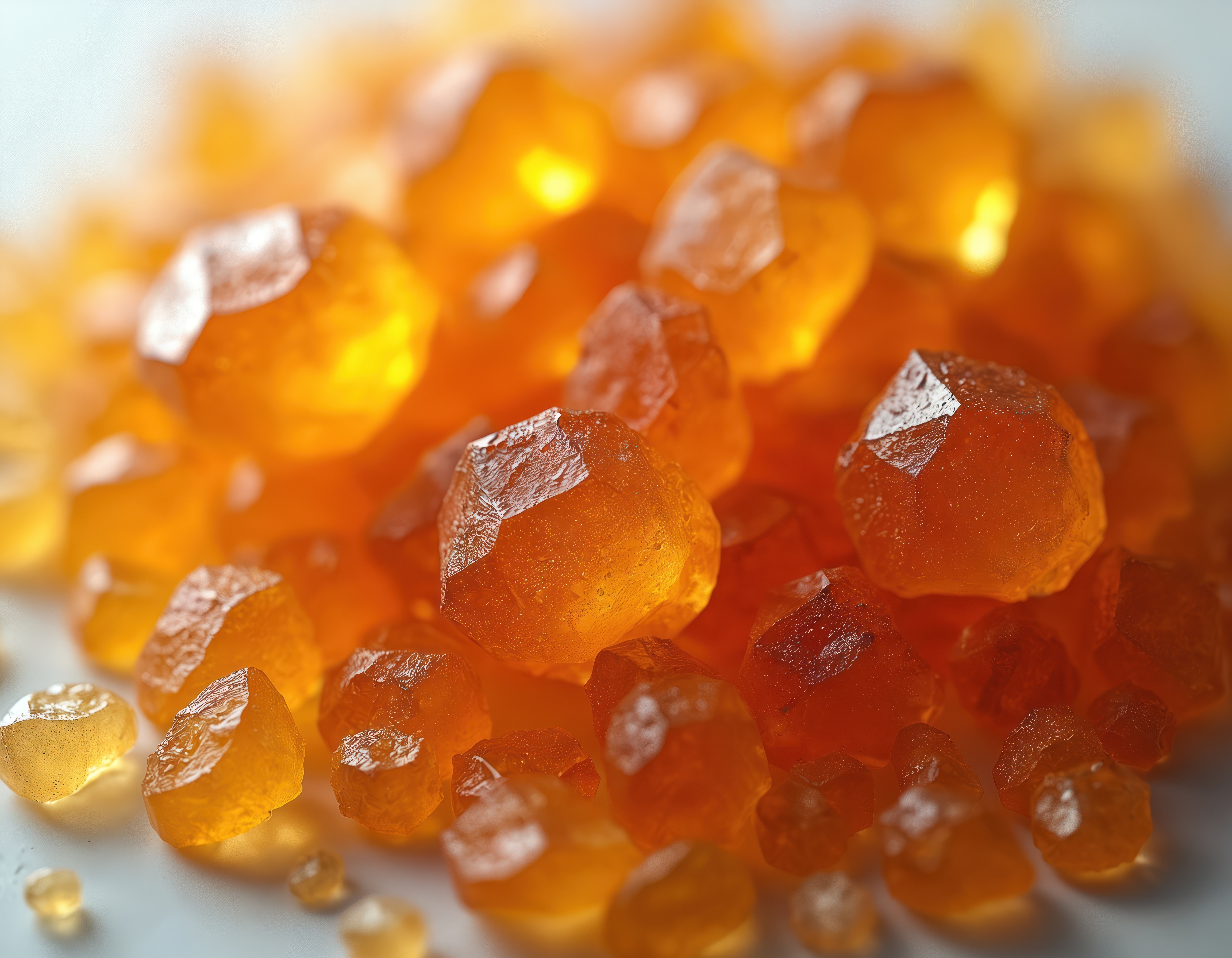
Acacia fiber, gum acacia, and gum arabic are three names for the same ingredient. Which name shows up on the label depends on the application and what the brand wants to communicate. Which grade you use depends on the processing requirements.
What acacia fiber brings to a formula
A few properties make acacia fiber genuinely useful across a range of product types.
Complete solubility. Acacia fiber dissolves fully in water. No grit, no texture at typical use levels, no visible undissolved material. In beverages especially, this matters: psyllium and some other fiber sources create perceptible texture or cloudiness at the doses needed to deliver meaningful fiber content.
Low viscosity impact. Compared to most dietary fibers, acacia fiber has a minimal effect on viscosity at concentrations up to about 10% in water. Guar and psyllium thicken solutions significantly. Inulin-type fibers start affecting texture around 5–8%. Acacia fiber stays fluid, which makes it compatible with beverage and thin-liquid applications where texture modification isn't the goal.
Neutral flavor profile. At 5–10% in a finished product, acacia fiber contributes almost nothing to flavor. Inulin-type fructans turn distinctly sweet above about 10%. Psyllium has a noticeable flavor. Acacia fiber is close to flavorless at practical use levels, which preserves the flavor system of the host product.
Good GI tolerance. At doses up to 20–30g per day, acacia fiber is well-tolerated in most populations. This is a meaningful differentiator from inulin-type fructans, which cause gas and bloating in sensitive individuals at doses above 8–10g. For products targeting daily use at high fiber doses, tolerance matters.
FDA-classified dietary fiber. Acacia fiber is listed by FDA as a dietary fiber under 21 CFR 101.9, which means it counts toward the Dietary Fiber line on the Nutrition Facts panel without any additional substantiation. More on the regulatory framework in the companion article linked in the sidebar.
Application-by-application use rate guide
RTD beverages: 5–12% by weight. Fully soluble, no grit, minimal viscosity impact. A 12 fl oz serving at 5% delivers roughly 17g of fiber. Works in still and carbonated beverages. Compatible with low-pH beverage systems.
Powdered drink mixes: 15–30% of the dry blend. Good powder flowability: acacia fiber doesn't bridge or clump in hoppers the way psyllium or inulin-type fibers can at high loadings. Blends well with other supplement ingredients.
Nutrition bars and snacks: 8–20% by weight. Acts as a mild binder and moisture management aid in addition to contributing fiber. Extends shelf life in bar applications by reducing water activity at the surface. Compatible with most bar matrix systems including high-protein and low-sugar formats.
Supplement powders targeting prebiotic or fiber claims: 20–50% of the blend. Acacia fiber handles high loadings without creating the flavor or texture problems that limit other prebiotic fibers at these concentrations. This is the category where flavor neutrality matters most.
Yogurt and dairy analogs: 3–8% by weight. Adds mild body without creating a gelled texture. "Acacia fiber" reads cleanly on a yogurt label in natural channel positioning.
Bakery and baked goods: 2–8% of the flour weight. Modest water retention benefit and fiber content contribution. Works as a partial replacement for some of the hydrocolloid stabilizer content in high-fiber bread and cracker formulas.
Grade selection
Both species work for fiber applications. Grade selection is driven by processing requirements and cost rather than meaningful functional fiber differences. Type 4810 (agglomerated senegal) and Type 4880 (agglomerated seyal) are the fast-hydrating options for RTD beverage mixing and dry-mix sachets. Type 4687 (senegal) and Type 4911 (seyal) are the standard powder forms. Type 4911 and Type 4886 are the Oregon Tilth certified organic grades for products with NOP requirements.
Grade guidance for fiber formulation
Both senegal and seyal species available in spray-dried and agglomerated forms, conventional and Oregon Tilth certified organic. The FDA regulatory context is covered in the companion article on the FDA dietary fiber definition.
Request a Sample