The same natural gum appears on US food labels as "gum acacia," in EU ingredient declarations as "E414," in Sudanese commodity markets as "Hashab," in French colonial trade records as "gomme arabique," and in 18th-century European pharmacy as "gummi arabicum." The botanical literature has called it Mimosa senegal, Acacia senegal, and since a contentious 2005 reclassification, Senegalia senegal. Its seyal counterpart has its own parallel set: Talha, friable seyal, Acacia seyal, Vachellia seyal.
That's at least sixteen distinct names in active use across trade, regulation, and science. They all trace back to one ingredient harvested from wild acacia trees across a narrow belt of sub-Saharan Africa. Here's where each name came from.
Why "Arabic" when it comes from Africa
The gum doesn't come from Arabia. It never did. The name traces to the Arab traders who controlled the trans-Saharan and Red Sea trade routes for centuries. Gum harvested in Sudan and the wider Sahel moved north by camel caravan, passed through Arab trading ports along the Red Sea coast and the North African Mediterranean, and reached European merchants through Arab intermediaries.
Europeans called it what they heard: the gum of the Arabs. In Arabic, samgh arabī (صمغ عربي) means simply "Arabic gum." Medieval Latin pharmacopoeias recorded it as gummi arabicum. That became gomme arabique in French, Gummiarabikum in German, and "gum arabic" in English. The commodity name attached to the trade route and stayed there. The gum's actual origin in sub-Saharan Africa was never part of any of these European names.
It gets more layered. "Sahel," the region where the trees actually grow, is itself an Arabic word. Sāḥil means "shore" or "coast," referring to the southern edge of the Sahara desert. Arab geographers named the landscape. Arab traders named the gum. European buyers recorded both without ever reaching the source.
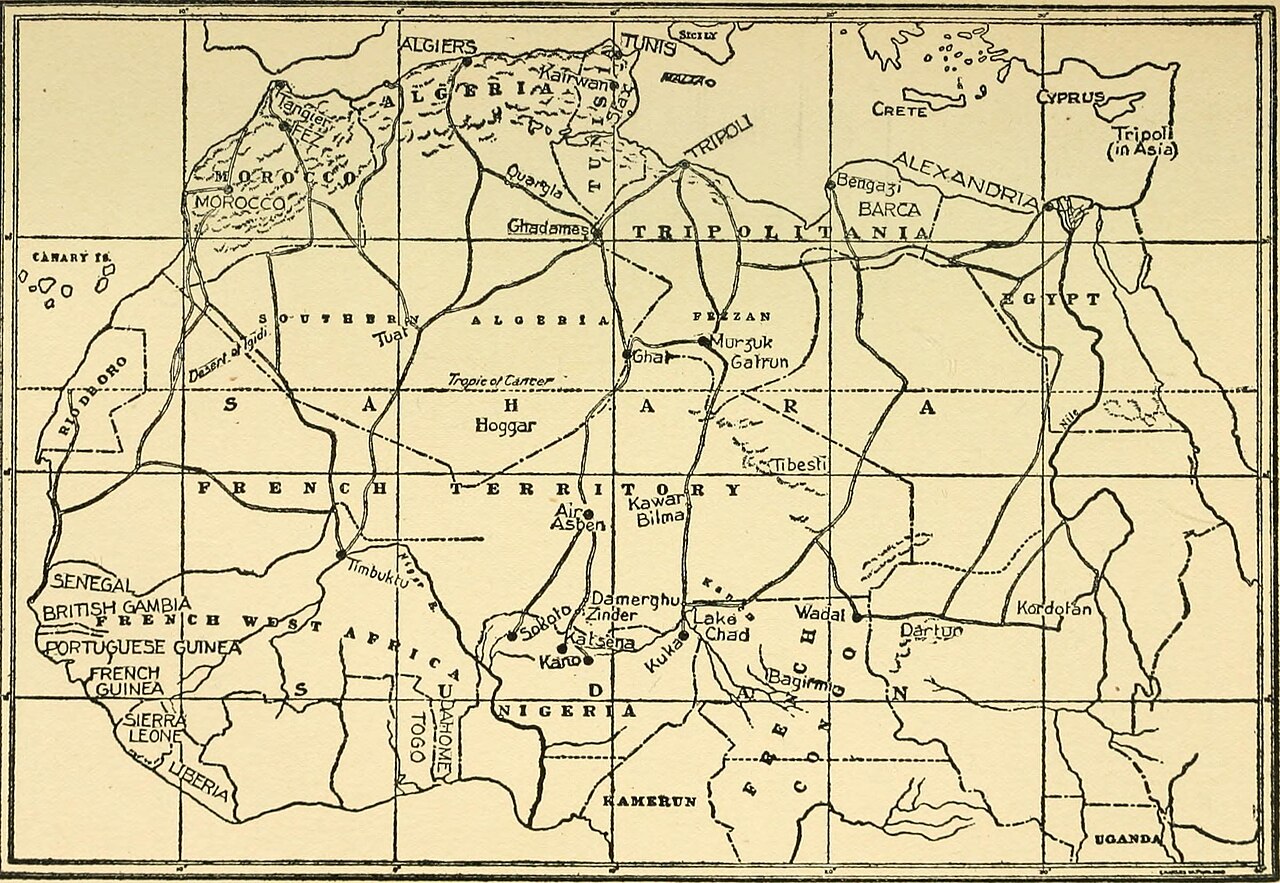
North Africa and the Sahara, 1909. Arab trade routes ran from the Sahelian interior north through the desert to Mediterranean ports, carrying gum arabic long before European buyers named it.
The Sahel and the gum belt
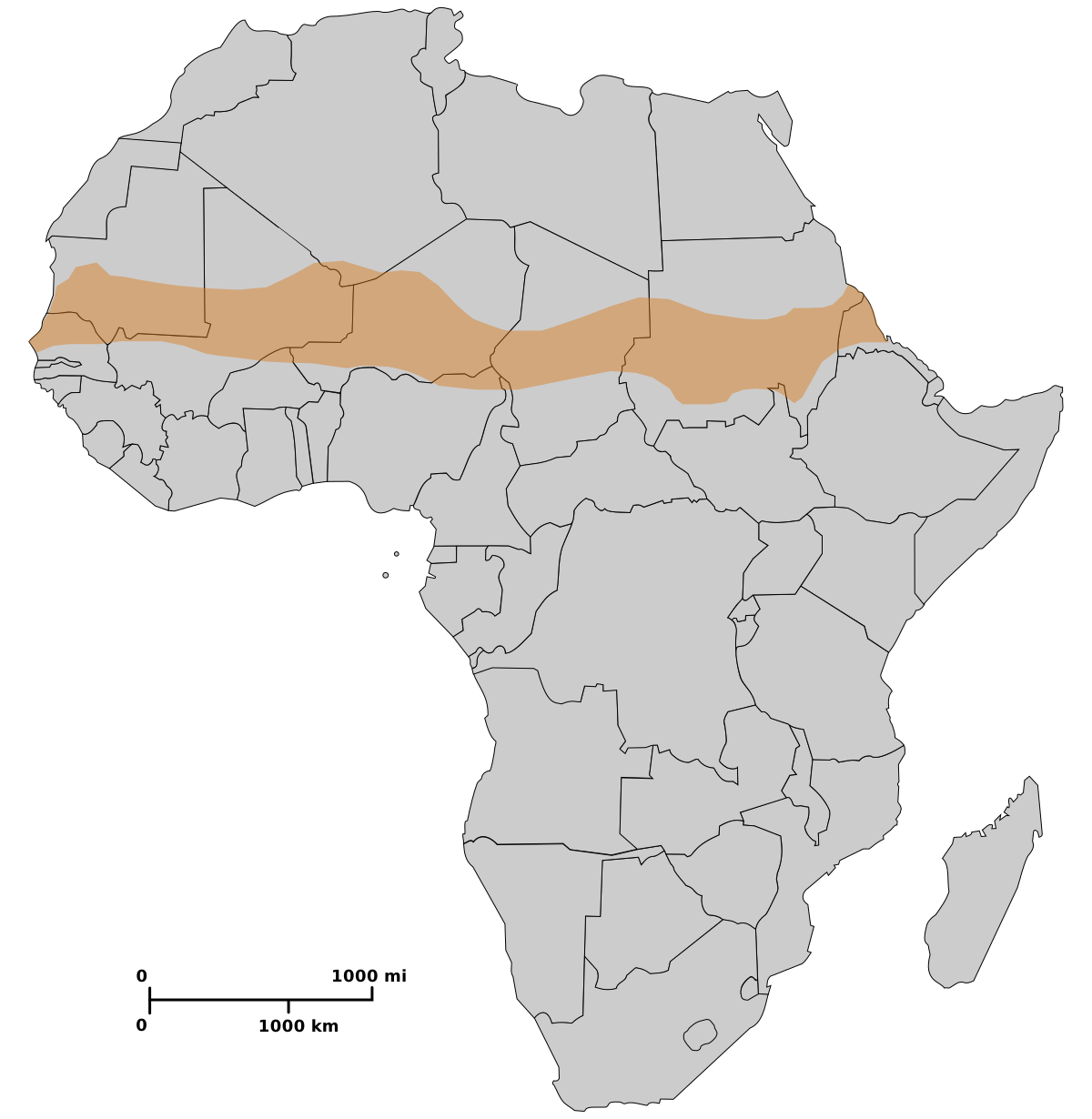
The Sahel, stretching from Senegal east to Ethiopia. The Gum Arabic Belt runs through this zone, roughly between 9 and 15 degrees north latitude.
The gum arabic tree grows in a band of semi-arid savanna running from Senegal in the west across Mali, Burkina Faso, Niger, Nigeria, Chad, Sudan, and into Ethiopia and Eritrea. Bounded to the north by the Sahara and to the south by wetter forest-savanna, the trade calls this zone the Gum Belt. Sudan has historically produced the majority of the world's supply, with estimates typically in the range of 70 to 80 percent of global production in any given year.
Two species do most of the commercial work. Acacia senegal grows throughout the belt but is most concentrated and highest-quality in the drier northern zones, particularly in Sudan. Acacia seyal grows further south, tolerates wetter conditions, and is the dominant species across much of Chad. The two produce gums with meaningfully different functional profiles. Most of the naming complexity in this article traces back to that one distinction.
Hashab and Talha: the names in the market
In Sudan, nobody calls it gum arabic. In the markets of Khartoum and El-Obeid, the commodity trades under local names that are specific to species. Hashab (هشاب) is the common Arabic name for Acacia senegal, both the tree and its gum. Talha (طلح) is the name for Acacia seyal. When a Sudanese trader refers to Hashab, he means senegal. When he says Talha, he means seyal. The species distinction is built into the market terminology in a way that the English trade name "gum arabic" entirely obscures.
These names are not just colloquial. They appear in government trade statistics, export documentation, and in the contracts that move gum from the Sudanese interior to the port at Port Sudan. Suppliers and buyers who work directly in Sudan use them. If you've ever seen "Hashab" or "Talha" on a specification sheet, it's species identification, not a brand.
Kordofan: when a province becomes a standard
North Kordofan state in central Sudan is the heartland of Acacia senegal production. The soil, rainfall pattern, and tree population there produce gum with a particularly high arabinogalactan-protein content, the fraction responsible for most of the emulsification and film-forming performance that makes senegal the preferred grade for food manufacturers. Over centuries of trade, the name of the province attached to the quality designation.
"Kordofan gum" entered the European trade vocabulary as a provenance marker, much the way Champagne or Darjeeling function in their categories. It meant: Acacia senegal, from the best production zone in Sudan, in lump or cleaned form. It carries connotations of quality that a generic "gum arabic" shipment description does not.
Hashab and Kordofan are not synonyms, but they overlap. Hashab names the species. Kordofan names the origin. "Kordofan Hashab" is the full precision: Acacia senegal from North Kordofan. In the commercial world, "Kordofan gum" typically implies both the species and the provenance.
Talha, friable seyal, and the French thread
Acacia seyal from Sudan trades as Talha. The same species from Chad trades under a different set of terms, and that difference has colonial roots. Sudan was a British protectorate. Chad was a French colony. The commodity terminology that developed in each territory reflected the language of the administering power.
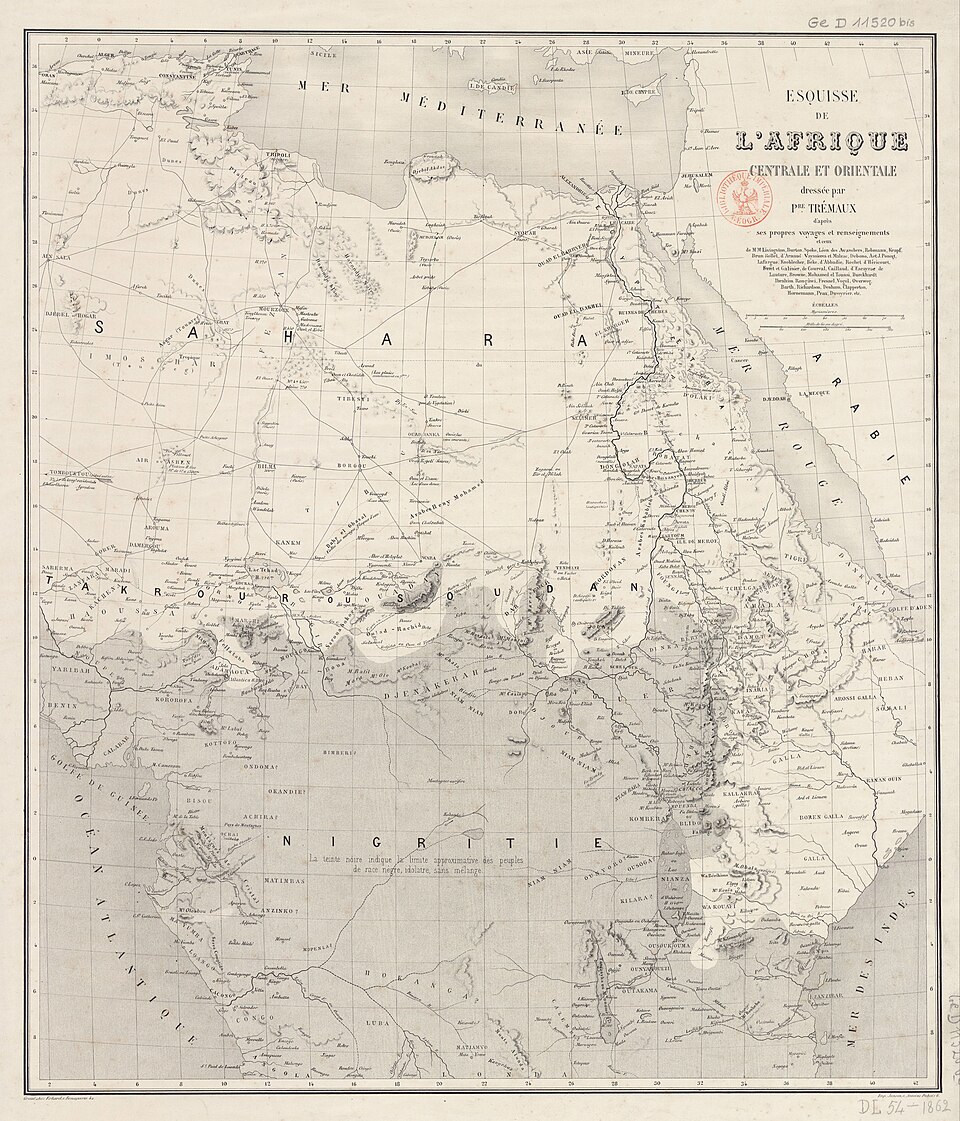
Central and Eastern Africa, 1862, in French. Sudan and Chad were administered by different colonial powers, and the gum trade terminology that developed in each territory reflected that divide.
The French trade term for Chadian seyal gum is "friable," from French, meaning brittle or crumbly. The gum breaks differently than Sudanese seyal. The tree populations differ, the soils differ, the harvesting and collection practices differ. In practice, bags of Chadian seyal crack and crumble when handled roughly. The story told in the trade is that you can identify Chadian from Sudanese seyal by what happens when you step on a bag. The French word for the sound and feel of it entered the English-language trade vocabulary and stayed.
"Friable seyal" is not a botanical category. It's a trade distinction based on physical behavior, geographic origin, and the linguistic inheritance of French colonial administration. A formulator specifying "friable seyal" is asking for Chadian gum, which typically means lower viscosity and different gelling and film-forming behavior compared to Sudanese Talha.
The taxonomy dispute: four botanical names for two trees
Linnaeus described the senegal tree in 1753 and placed it in the genus Mimosa, calling it Mimosa senegal. Early in the 19th century, botanists moved it into the newly described genus Acacia, where it became Acacia senegal. Acacia seyal was described separately around the same time. Older literature also uses Acacia vera, a name applied to some senegal-type material before nomenclature stabilized. All of this was happening in parallel with the commercial trade vocabulary, mostly invisible to the buyers and traders who were just calling it Hashab or gum arabic.
In 2005, the International Botanical Congress in Vienna approved a sweeping reclassification of the Acacia genus. The genus was split, with different species moved into new genera. Acacia senegal became Senegalia senegal. Acacia seyal became Vachellia seyal. The reclassification was botanically grounded and has been adopted in many scientific publications.
The food industry, regulatory agencies, and virtually all commercial documentation have not followed. The Joint FAO/WHO Expert Committee on Food Additives (JECFA) still uses Acacia senegal. The EU specification for E414 references Acacia senegal. The FDA's GRAS designation uses Acacia senegal. Ingredient suppliers, food manufacturers, and industry associations worldwide still use Acacia senegal and Acacia seyal. Unless and until regulatory bodies update their reference specifications, the old botanical names will continue to govern commercial practice, regardless of what the taxonomy journals say.
What the regulators call it
The food regulatory world has its own parallel naming system, independent of both the trade vocabulary and the botanical literature.
In the European Union, the ingredient is authorized as a food additive under the number E414. It appears in EU ingredient declarations as either "E414" or "gum arabic." Both are legally compliant.
The Codex Alimentarius (the international food standards system) uses INS 414, where INS stands for International Numbering System. This number appears on documentation for trade between countries using Codex standards.
In the United States, the FDA has long listed gum arabic as GRAS (Generally Recognized as Safe). In recent years the FDA and the food industry have both moved toward preferring the term "gum acacia" on ingredient labels, partly to avoid geographic confusion (it doesn't come from Arabia) and partly because "acacia" is the taxonomic genus name. "Gum arabic" remains permitted and is still widely used, particularly in products with longstanding labels. "Acacia gum" appears in some documentation as a variant of the same.
A fourth US label term has gained traction more recently: "acacia fiber." Manufacturers use it when the ingredient's primary role is dietary fiber contribution rather than emulsification or texture. It's not a separate regulatory category: gum acacia and acacia fiber are the same material under the same GRAS status. But the FDA's 2016 dietary fiber definition under 21 CFR 101.9 confirmed gum acacia as a qualifying dietary fiber, and the food industry has leaned into acacia fiber as the label name for fiber-enrichment applications. Supplement and functional food brands in particular use it because "fiber" signals a consumer benefit in a way that "gum" does not. You'll see it used without issue on US products today.
A complete reference
All of the following names refer to the same natural ingredient or one of its two primary species:
| Name | Origin | Species / Scope |
|---|---|---|
| Gum Arabic | Arab trade routes → European commerce | Both species; historically senegal-dominant |
| Arabic Gum | Word-order variant of the above | Both species |
| Gum Acacia | Food industry and regulatory preferred term | Both species |
| Acacia Gum | Variant of gum acacia | Both species |
| Acacia Fiber | US label use; fiber-forward framing under FDA 21 CFR 101.9 dietary fiber definition | Both species |
| Gomme Arabique | French; same trade-route etymology | Both species |
| Gummiarabikum | German; same etymology | Both species |
| E414 | EU food additive authorization | Both species |
| INS 414 | Codex Alimentarius international numbering | Both species |
| Hashab | Arabic/Sudanese name for the senegal tree | Acacia senegal only |
| Kordofan Gum | Provenance: North Kordofan state, Sudan | Acacia senegal, premium grade |
| Talha | Arabic/Sudanese name for the seyal tree | Acacia seyal only |
| Friable Seyal | French colonial trade terminology; Chad | Acacia seyal from Chad |
| Acacia senegal | Botanical; 19th-century classification; still dominant in commerce | Species 1 |
| Senegalia senegal | 2005 Melbourne Code reclassification | Species 1 (not used commercially) |
| Acacia vera | Historical botanical name; pre-19th century | Species 1 (obsolete) |
| Mimosa senegal | Linnaeus, 1753; original classification | Species 1 (obsolete) |
| Acacia seyal | Botanical; 19th-century classification; still dominant in commerce | Species 2 |
| Vachellia seyal | 2005 Melbourne Code reclassification | Species 2 (not used commercially) |
What to call it and when
For US food labels, "gum acacia" is the cleaner choice. It's the FDA-preferred term, it avoids the geographic misnomer, and it's increasingly what clean-label-conscious brands use. "Gum arabic" is still compliant and still widely understood. If the ingredient's primary function in your product is dietary fiber, "acacia fiber" is the right label name. The FDA's 2016 dietary fiber definition confirmed it qualifies under 21 CFR 101.9, and the name communicates the benefit rather than the additive category. Products positioned around prebiotic fiber or digestive health routinely use it.
For EU labels, "gum arabic" or "E414" are both correct. Either is legally permissible under current regulation.
On specification sheets and purchase orders, the botanical name still matters. Specifying Acacia senegal and Acacia seyal separately, by species, is the only way to get consistent functional performance across orders. A specification that says only "gum arabic" leaves species selection to the supplier. That matters when you're formulating for emulsification (where senegal outperforms) versus mouthfeel or film-forming in a different application type.
If you've seen "Kordofan" or "Hashab" on a technical data sheet or a supplier offer, that's a positive indicator. It means the supplier knows which species they're selling and where it came from.
Both species. Multiple grades. Species-level documentation on request.
PAT Ingredients stocks Acacia senegal and Acacia seyal in spray-dried and agglomerated grades, conventional and Oregon Tilth certified organic. We specify by species on every order. Samples and technical data available.
Request a Sample