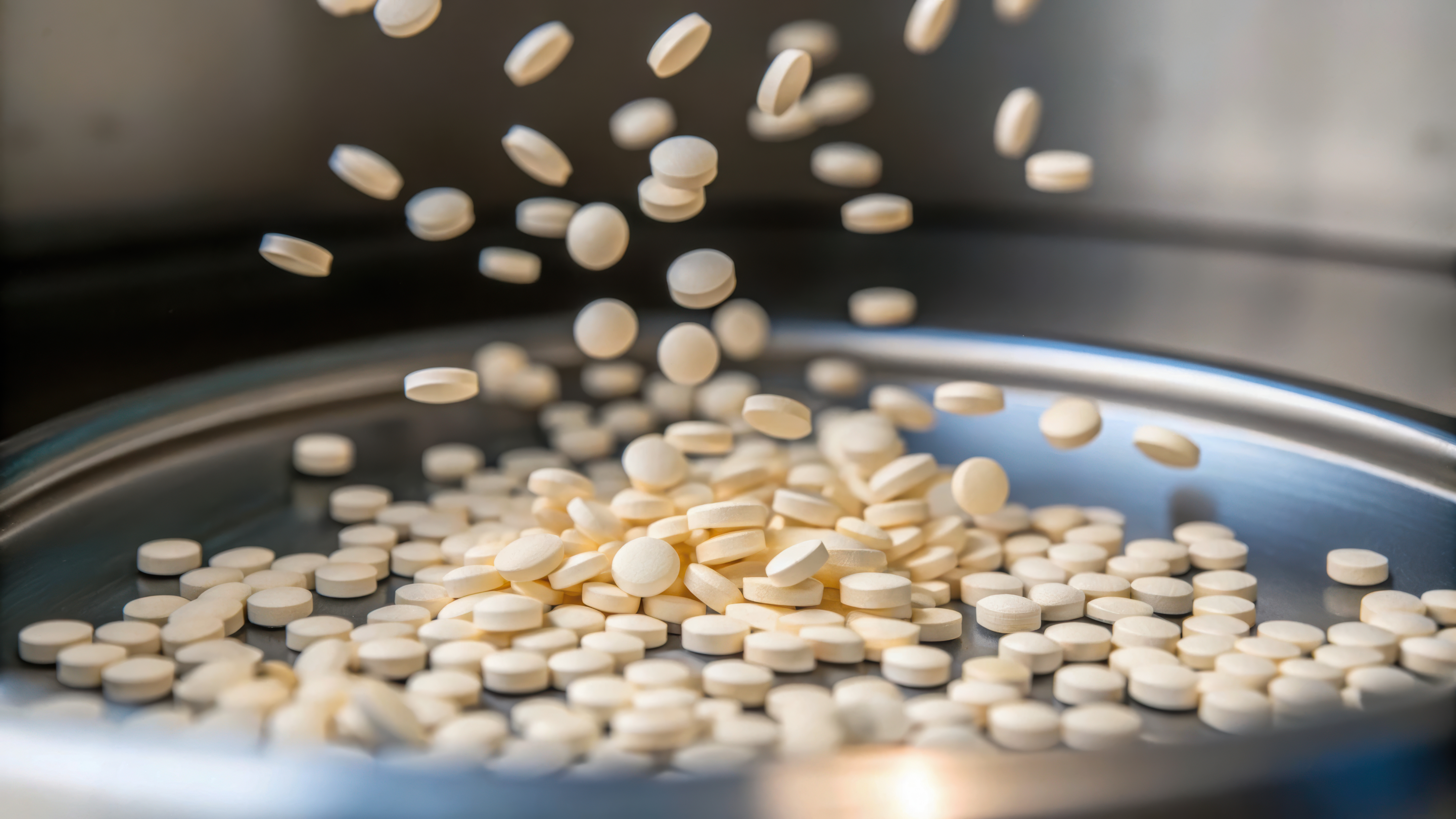
Gum acacia is a natural binder option for supplement tablet manufacturing. It's less common than PVP or HPMC, but it has a clear role in clean-label formulas and in products where adding a fiber contribution to the tablet is a feature rather than incidental.
What tableting binders do
A binder holds granule particles together under compression, giving the finished tablet its hardness and cohesion. Without sufficient binder, tablets are friable: they chip, crack, or crumble during manufacturing, coating, and handling. Too much binder and dissolution slows down, which affects bioavailability.
Binders are applied either as a solution during wet granulation or as a dry powder in direct compression blends. Each method has different requirements for the binder's physical properties.
Gum acacia in wet granulation
In wet granulation, gum acacia is dissolved in water at 10–20% concentration and used as the granulating fluid. As the granulating liquid is mixed into the dry powder blend, the gum acacia solution wets the particles and distributes through the mass. When the granulate dries, the gum acacia deposits at particle contact points, forming adhesive bridges between granules.
The resulting granules have good compressibility and low friability. Tablet hardness is consistent across the batch when granulation is done well. The gum acacia binder contribution is modest but reliable, and it doesn't create the film-coating adhesion problems that some synthetic polymers can.
Gum acacia in direct compression
At 2–5% in a direct compression blend, gum acacia powder distributes around particle surfaces during mixing and acts as a compaction aid during tableting. It works best with coarser, free-flowing grades that don't segregate in the blend.
Direct compression with gum acacia is most practical for lower-dose formulations where the tablet weight allows room for excipient inclusion without the tablet getting too large to swallow.
Why Acacia seyal is the preferred species
Acacia seyal has lower molecular weight than Acacia senegal, which means faster and more complete hydration in granulation solutions. It dissolves more readily in the granulating fluid and distributes more evenly through the powder mass during mixing. Binding strength is comparable to senegal for typical tablet formulations.
Seyal also tends to be more cost-effective at equivalent grades, which matters when gum acacia is included at 2–8% of the total tablet weight across a high-volume run.
Grade selection
Type 4880 is the agglomerated, fast-hydrating seyal — the practical choice for wet granulation and direct compression work. It disperses quickly in granulating solutions and handles well in industrial powder systems with less dusting than standard spray-dried grades. Type 4911 is the organic standard powder seyal, Oregon Tilth certified, for supplement tablets carrying USDA Organic certification.
Typical use levels
Wet granulation: 10–20% gum acacia in the granulating solution (dry weight basis), which translates to 2–5% gum acacia in the finished tablet.
Direct compression: 2–5% gum acacia in the dry blend by weight.
Clean label and fiber contribution
On a finished supplement label, "gum acacia" reads as a natural, recognizable excipient. It won't trigger consumer concern in natural channel products the way PVP (polyvinylpyrrolidone) or HPMC (hydroxypropyl methylcellulose) might for some buyers.
There's also a functional label angle: gum acacia is FDA-classified dietary fiber under 21 CFR 101.9. If the tablet has meaningful gum acacia content, it can legitimately contribute to the dietary fiber declaration on the Supplement Facts panel. For fiber supplement tablets, that fiber count can appear on the label. More on the FDA fiber classification is covered in the acacia fiber regulatory article linked in the sidebar.
Grade guidance for supplement tableting
Acacia seyal grades for tablet manufacturing: Type 4880 (agglomerated, fast-hydrating) for standard use, Type 4911 (organic standard powder) for NOP-certified formulas.
Request a Sample