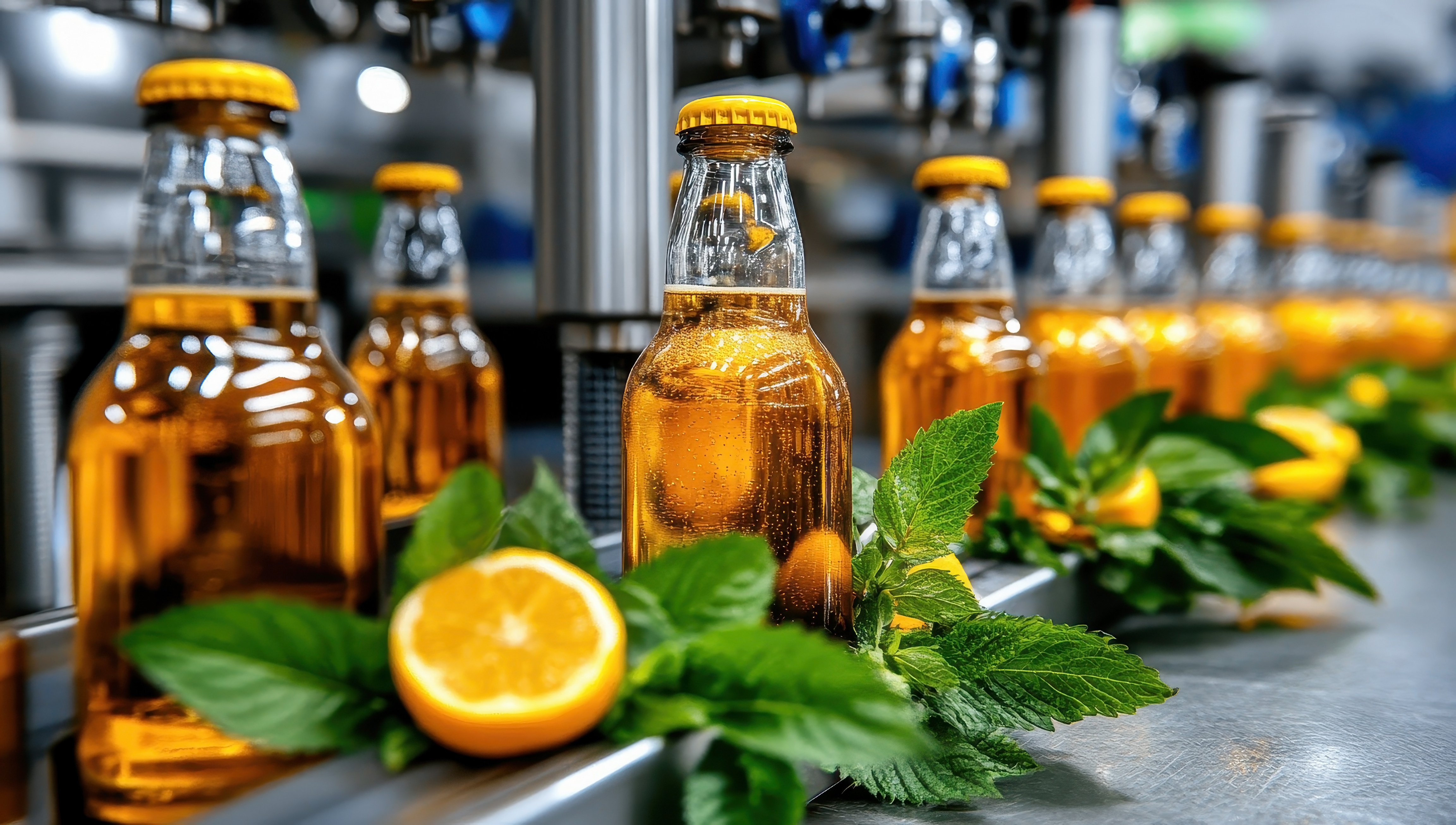
Oil-in-water emulsification is one of the oldest applications for gum acacia in food manufacturing. Citrus beverages, botanical RTDs, flavor emulsion concentrates: they all depend on it. The chemistry is well understood. Grade selection is where most formulation decisions get made.
Why gum acacia works for beverage emulsification
Gum acacia is a complex polysaccharide with a protein fraction bound at the core. The protein components anchor to oil droplet surfaces. The polysaccharide portions extend into the water phase, creating a dense hydrophilic coating around each droplet. That coating prevents droplets from coalescing, which is what keeps an emulsion stable over time.
The specific fraction responsible for most of the emulsification performance is the arabinogalactan-protein (AGP) complex. It makes up roughly 10–20% of gum acacia by weight but does the majority of the interfacial work. Higher AGP content generally means better emulsification performance.
The result is an emulsion that tolerates acidic conditions, high-Brix syrup, carbonation, and temperature cycling: the conditions found in most commercial beverage applications. This is why gum acacia is still the standard wall material for beverage emulsion concentrates despite the availability of alternatives.
Why senegal is the preferred species for emulsification
Acacia senegal has a higher AGP content than Acacia seyal. That translates to better film formation at the oil-water interface, smaller initial emulsion droplet size, and more durable stability in challenging beverage conditions. For beverage emulsion applications, senegal is the species to start with.
Seyal works for beverage emulsification at lower performance requirements, but if your product is an acidic citrus RTD or a botanical beverage with demanding stability specs, senegal grades hold up better across the shelf life.
Grade selection
For beverage emulsification, Acacia senegal grades are the standard choice. Type 4687 (standard spray-dried) and Type 4810 (agglomerated, fast-hydrating) are equivalent in emulsification performance; 4810 disperses in 10–15 minutes vs. 20–30 for 4687, which matters in production environments where hydration time between batches is a constraint. For organic-certified beverages, Type 4886 is the agglomerated senegal with Oregon Tilth certification.
Use levels and application notes
In emulsion concentrates, gum acacia is typically used at 20–30% of the total concentrate weight (dry basis). The oil-to-gum ratio in the emulsion feed is commonly 1:2 to 1:3. Higher oil loads are achievable but require more careful emulsification to control droplet size.
In finished beverages, effective gum acacia concentration is usually 0.3–1.0% by weight, depending on the oil content and stability requirements.
Gum acacia tolerates the low pH conditions of citrus and botanical beverages well. It's stable in the range of pH 3.0–7.0, which covers most commercial beverage applications.
Applications
Citrus flavor emulsions for RTD beverages are the most established application. Botanical extract emulsions for NA aperitifs and functional beverages are a growing one. Essential oil dispersions, natural clouding agents, and emulsified terpene systems in sparkling beverages are also well within the capability of these grades.
For non-alcoholic aperitifs and botanical beverages specifically, the combination of emulsification and mouthfeel contribution from gum acacia makes it more functional than a single-purpose emulsifier. That topic is covered in more detail in the NA beverage and mouthfeel articles linked in the sidebar.
Grade guidance for beverage emulsification
Acacia senegal grades (Types 4687, 4810, and 4886) for beverage emulsification. Conventional and Oregon Tilth certified organic available. Samples and technical data on request.
Request a Sample